|
Why
are rural citizens in the Chateauguay Valley rallying to "Save Our Schools"?
Parents, teachers and citizens were stunned to learn last fall that the New
Frontier School Board's Future Direction Committee recommended closing half of the Valley's rural
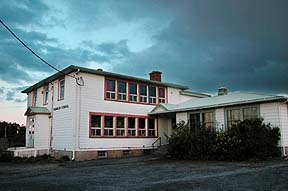
elementary schools. The announcement tears at the heart of these communities, Franklin, Howick and Huntingdon, leaving them with little hope for future economic revitalization.
The Board's FDC offered no alternatives, citing simply the need to cut expenditures.
But the Director-general stated that this is not so much about money as it is about pedagogy, which, he admitted, costs money.

Ken
Robertson, Director-general
|
The small schools claim they are part of the solution, not part of the problem. They are not asking for improved pedagogy; in fact their split age classes and low student to teacher ratios are exactly what is being prescribed by the "New Reform". Still, they recognize the need to work with the Board to find ways of making their institutions economically sustainable.
As school
administrators returned from a 3-day autumn retreat at an Eastern Townships
resort, serious suggestions were made about another option that would cut
expenditures at the administrative level.
The citizens
cited erroneous figures in the Board's Future Directions Committee
report that led to the school closing decision. Questionable maps and enrolment
statistics and exaggerated maintenance cost data pointed to a
seemingly obvious solution of closing these schools.
What angered
the citizens in this geographically isolated part of Quebec is
that the Board's process forced each struggling school to point
accusing fingers at their sister schools in order to save themselves.
A once region-wide community was at risk of being broken into individual towns
each vying to avoid the Board's axe. Citizens claim they have
been victims of a divide and conquer conspiracy.
School commissioners, however, deny any top-side strategic maneuvering, and at recent face-to-face meetings with the citizens, they assure their constituents that they are working with very capable peers.
With their
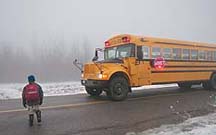
rural schools closing, some children will be riding a school bus
for 3 hours a day. Everyone agrees this is not healthy, physically or emotionally; few adults would accept such a daily commute. Already this is true for high
school students in St. Bernard de Lacolle, Hinchinbrooke, Dundee
and St. Timothee.
That fear of sending their small children on long bus rides to distant schools explains why parents from ordinarily polite
little country schools are standing up in anger. A Franklin Township
councilor told the governing board, "They want to take our children away from us, well, they can't have them."
Early in the process, the commissioners
were prevented from speaking
to their constituents. The D-g explained that the ban was to insure equity so that one school did not have more contact with the board than another. Despite the "gag order", one commisioner spoke at a Franklin School rally last spring and another was present at the special November
6 meeting in Howick. Another publicly contested the Board's ban measure at its
regular November 7 meeting.
Also at play
is the difference in values between the urban decision-makers
and the rural residents. Chateauguay's shopping malls,
commuter traffic and suburban housing developments is world's apart from the Valley's routine of 5 a.m. milking chores, cutting firewood
in the bush, and plowing snow from a kilometer-long driveway.
From an urban point of view, the little school is quaint but not worth the added cost of small class sizes. But to those who live out there, the rural
reality is all about community, neighbors helping neighbors, and
the school is a social hub for this English minority population.

With
few job opportunities, a constant exodus of youth, and the ongoing
farm revenue crisis, towns like Franklin and Howick hang on with
hopes that the economic revitalization that has swept through
Mercier and St. Martine
will eventually bring them some new life.
Howick is next in line for a
housing boom just waiting for their sewer infrastructure to be
built. But without
a school, young families will settle elsewhere. This issue goes
far beyond closing down schools; it's closing down towns.
In Huntingdon where hundreds of families were devastated last year with the closing of the textile mills, one of two English elementary schools could be on the Board's chopping block.
St. Joseph's School says they were unfairly represented in the Future Directions process and in the data book listing each school's facilities. Compared to the other schools,

|

there's was made out to look like they had very little, not even a library which they do have, thus an obvious target for closure, they claim.
Last
winter the New Frontiers School Board invited each governing board
to submit a proposal on how to make their schools more viable,
use the space efficiently, and think outside the box in terms
of coming up with creative solutions in the face of declining
enrolment.
Despite full
schedules of farming and parenting, Franklin's governing board
and citizen volunteers held meetings, brainstormed solutions,
analyzed costs, negotiated partnerships and wrote an impressive
document that even the Board commended. They believed that each
well-thought-out option would be looked at seriously and taken
to the next level by their school board representatives.

In September,
however, they were told simply that the little school in Franklin
along with 2 others would be closed. The only choices offered:
a) next year or b) the following year. One parent noted, "Two
guys sitting at the bar could have come up with that solution."
Perhaps what
is most frustrating is that many of the proposals from other Valley
schools pointed to the closure of Franklin as the solution, based
on the erroneous data provided them by the Board.
Some Franklin
citizens suggested that they played directly into the hands
of the Board which had long ago made up its mind about the decision
and sought only the written proof that a "public consultation"
had taken place.
But school commissioners say that no decision has yet been made and it will come down to a raising of hands at the Council of Commissioners' meeting on January 9, 2006.
Franklin parents point out that if their community school is closed, at least half of the students will be lost from the New Frontiers School Board as they move into the St. Antoine French school or home-schooling. The savings of $110,083 that it takes to run the school would be nullified by the loss of $5,500 per student funding that comes from the Quebec Education Ministry.

One idea
to keep students near home is to begin serious discussions with the
other small school in the municipality, Ecole Primaire St-Antoine.
Perhaps the time is ripe for the two linguistic communities to
join forces. This French school and the one in St. Chrysostome
weathered their own round of closure threats a few years ago and
still face that possibility due to declining enrolment. If both schools cannot be kept open then at least some sort
of merger could keep all of the Franklin Township children in
Franklin.
This
idea is in line with the recent flurry of media attention given
to Alex Patterson and a special advisory council to the
Quebec English School Board Association. They promote a sharing
of resources between French and English schools. There are already
models in Quebec where either a building is shared or they have merged two separate schools into one.
Parents are
willing to look at any other option than bussing their young children
out of town. At the November 6 meeting, the
Director-general dismissed any possibility of supporting a private
or semi-private scenario but citizens in the targetted towns are also discussing that possibility.
The economic impact of school closures has come to light as other town leaders hear of the pending closures. In Howick the mayor has been present at every school board meeting and in Franklin one of North America's largest food processing plants has expressed genuine concern about the consequences. See Mike Leahy's letter in "Commentary".
The Franklin School is a glimmer of hope that our society can still be a hospitable place. Young children are cradled here in a caring community within a community, a human buffer against a speedy outside world.
Here each individual matters and each develops his/her unique abilities at their own pace. They are not in a modern school youth ghetto, rather they are exposed to people of all ages and from all walks of life who pass freely between school and community.
Yet they are not isolated from the real world. Parent carpools carry them to Ottawa, Montreal and Quebec City as well as on local field trips -- woodland snowshoe outings, apple picking and maple sugaring right across the street.
Citizens are heartened by a story recounted by old-timers who remember a visit to a nearby town hall by the late great educator Dr. Howard S. Billings. He was touting the benefits of consolidation, closing one-room schools and transporting students to local high schools, the beginnings of amalgamation.
An old farmer is said to have stood up and stated to Dr. H.S.B.'s delegation, "You can take your fancy suits and your fancy cars and your fancy ideas and go back to Quebec City." |